

At the Center for Media & Social Impact (CMSI), we love bringing together thinkers and doers to make comedy together. And it’s even better when the comedy and play can help us deal with tough topics—or translate complicated ones. So, what better topic to tackle than getting Americans to maybe get on the same page about how to build a future that feels just and civil and positive, right?
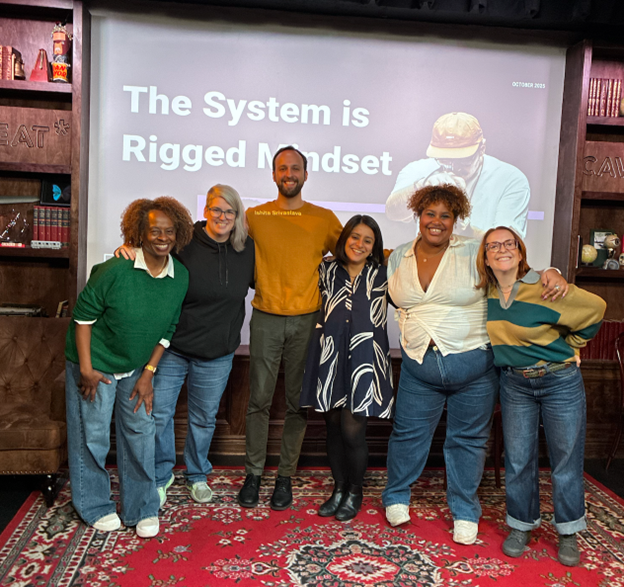
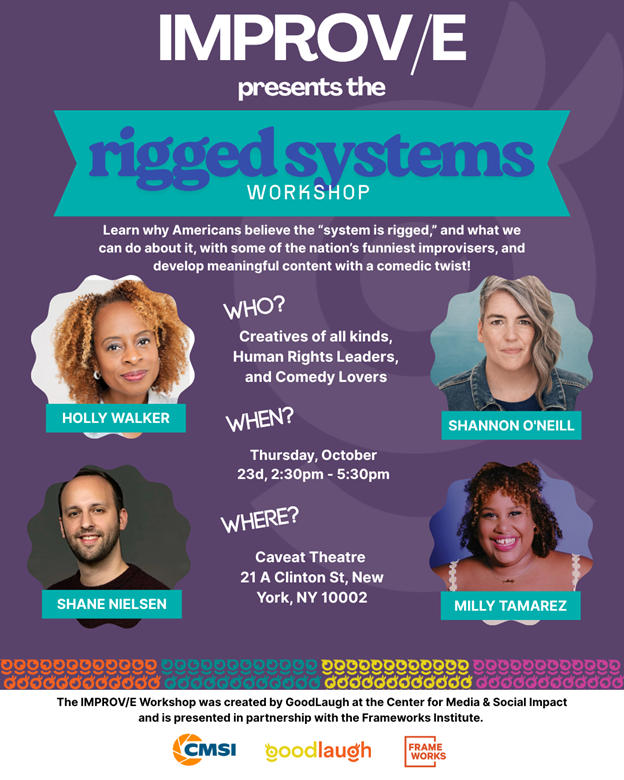
With this in mind, CMSI linked up with the Frameworks Institute, a nonprofit think-tank that studies mindsets (widely shared and subconscious patterns of thinking) and tests ways of storytelling and communicating that can move people towards action, for the ‘IMPROV/E RIGGED SYSTEMS WITH COMEDY’ workshop. The purpose of this intimate gathering in NYC was to explore how improv comedy can be used as a tool to infuse powerful, game-changing, research with artistic vision. The workshop was composed of representatives from CMSI and Frameworks as well as top-notch improvisers and a hands-on audience of artists, comedians, and activists. Here, we learned not only the importance of understanding mindsets, but also the serious power of spontaneous, judgement-free, brainstorming and play.
What is a ‘mindset”?
If we think about “mindsets” as the mental frameworks and mental models we use to make sense of the world around us—and to guide how we feel and act—then we can see why understanding specific mindsets is so important, particularly when it comes to how our democracy functions. Importantly, mindsets can consciously and subconsciously influence our behavior and impact the way we view the world around us.
Certain mindsets may be familiar to you, even if the terminology is not. For example, one common, dominant mindset in the United States is that of individualism, which assumes that the outcomes of a person’s life are almost entirely due to their character, grit and hard work. The individualism mindset makes sense of things without taking into account that what surrounds us shapes us, including systemic issues, familial economics, or social environments.
What does it mean to say (and think) “the system is rigged”?
As explained by Ishita Srivastava, Frameworks’ Vice President of Cultural Strategy, one mindset dominating the way Americans are thinking right now right now is that the “system is rigged” (and by “system,” we mean all of them, including all the big ones: political system, healthcare system, economic system, education system etc.). And they’ve found that without some guidance, this mindset leads people to feel fatalistic and helpless, and some versions of it can also lead to xenophobia and racism. So, what are we to do about this? It boils down to a few key points:
- Acknowledge that the systems are indeed rigged.
- Talk about unrigging the system in ways that center collective power.
- Focus on HOW the systems are rigged rather than WHO is rigging them.
- Offer solutions, and ensure that they match the scale and gravity of the problems.
Where does improv comedy come in?
Led by our Creative Director of Comedy Initiatives, Bethany Hall, and improv icon, Shannon O’Neill, after thoroughly unpacking the research, some of our nations best improvisers (Holly Walker, Shane Neilsen, and Milly Tamarez) used improv comedy to generate new and original ideas to breakdown the problems and spotlight solutions, within the “system is rigged” mindset and narrative, all the while creating a playful creative space. Some spontaneous scenes included:
- Halloween Book Rebellion: in this scene children used the concept of collective rebellion when a neighbor decided to hand out books in lieu of candy on Halloween.
- The Boss’ Nephew: A highly qualified, disgruntled employee expresses their dismay when their boss’ nephew receives a promotion rather than them, modeling one way that the system is rigged.
- Oscar Thank You’s: In this acceptance speech, the Oscar winner thanks only themselves, insisting that their success was due exclusively to their ability to pull themselves up by their bootstraps.
What kinds of creative ideas can come from comedy play?
After settling into the space through comedy, we focused on developing new, comedy forward, and producible projects. During this exercise, we worked with our audience, primarily composed of comedians and folks working in the social justice space, to generate their own ideas on how to grapple with this mindset and bring productive narratives about unrigging systems into their own work. By the end of the workshop, dozens of ideas had been shared. Some were great, some were weird, and all were welcome. Here are some of our favorites:
- Systemic Themepark (themepark): An enormous Rube Goldberg-esque park that requires individuals to work together to make their way from one end of the park to the other (alt: collective action escape room).
- How Does it Run (docu-series): This show takes you behind the scenes of some of our nation’s greatest systems and explains exactly how they are run. Focused on the systems and not the folks behind them, ‘How Does it Run’ demystifies everything from professional baseball teams to being elected for congress.
- Guess How (boardgame): A cheeky spinoff of the acclaimed game ‘Guess Who’, ‘Guess How’ models different folks living in America and players get to guess how systems have worked to keep them down.
- Eww…Hot (comedy podcast): This comedy forward podcast showcases healthy debate between folks with opposing viewpoints. There are rules, there are opinions and there is a referee.
- We the People (public art mural): The public is invited to paint longstaying portraits of individuals they love alongside one another, creating a visible chorus of love in shared spaces.
Ultimately, it was an uplifting and inspirational day, and a fantastic reminder that change is possible when great minds come together prepared to “yes, and…”
PRESENTING PARTNERS
Center for Media & Social Impact (CMSI) based at American University’s School of Communication, is an award-winning creative innovation lab and research center that focuses on media for equity and social justice. Our work bridges boundaries between scholars, media producers, social justice organizations, and communication practitioners. GoodLaugh, a CMSI initiative, is a comedy production engine and knowledge lab that brings together the most talented minds in humor, social justice, entertainment, and philanthropy to collaborate and create comedic content and insightful research to help repair the world and build a more just, equitable future.
The Frameworks Institute: The FrameWorks Institute is a nonprofit think tank that helps organizations and storytellers committed to social change to communicate in ways that shift narratives and build public demand for progressive change. We study cultural mindsets—how people understand social issues and develop and test strategies to shift thinking and build support for action. For 25 years, FrameWorks has helped change the conversation on issues like child and adolescent development, climate change, health equity, public education, and structural racism. FrameWorks staff—a multidisciplinary team of social scientists, narrative and cultural strategists, and communications professionals—has pioneered Strategic Frame Analysis®, a one-of-a-kind approach to communications that combines insights from social science, social movements, and social change communications. International, national, state and local partners, and content creators use our insights and guidance to secure more equitable, inclusive and sustainable policies.
Hope to see you there!